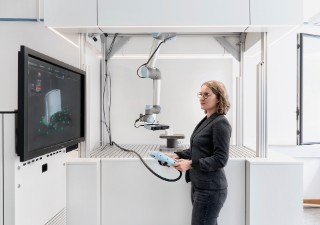
Intelligent decision support systems can help prevent sudden major disruptions caused by absences.
more info
Intelligent decision support systems can help prevent sudden major disruptions caused by absences.
more info
Without a plan and strategy, sustainability can cause considerable costs. A new in-house training program teaches concepts, methods and technical solutions alike.
more info
In volatile times, one thing matters more than ever: Both production and products must be safe and reliable. At the IWF of TU Berlin, industrial safety is addressed from many angles.
more info
The ReTraNetz-BB real-world laboratory supports the local vehicle and supplier industry’s turnaround. Process chains are tested here and technologies are transferred into real-life scenarios.
more info
Steel as a sustainable lightweight material? What appears contradictory at first could revolutionize the design of battery housings for electric vehi-cles, making e-mobility even more eco-friendly.
more info
Ready for digitalization in production? With the help of an AI-based learning platform, SMEs can prepare their employees for their individual roles in a digitally integrated production.
more info
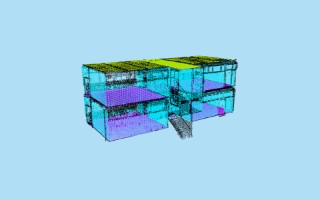
Existing buildings are responsible for one third of all carbon emissions in Germany. In order to renovate them efficiently on the basis of 3D models, the Scangineering process is being adapted.
more info
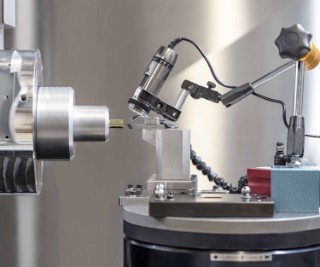
Many machining companies face the same dilemma. They collect process data during production, yet expertise for contextualizing and evaluating it is often missing. Triggered sensors can help.
more info
Generative AI is revolutionizing the way we interact with knowledge. How can companies take advantage of this development to manage their domain knowledge?
more info
Keeping emissions in focus: Benchmarking greenhouse gas emissions enables quick comparisons of sustainable business developments.
more info
Starting at the end of 2020, companies will be able to test factory processes in a 5G infrastructure in the PTZ test field.
more info
Artificial intelligence requires large quantities of data? Not necessarily, say scientists at Fraunhofer IPK. They use visual quality control for industrial goods to show how it can work.
more info
Within the framework of the research project BioFusion 4.0, data-driven solutions for a more sustainable and resource-efficient production are being developed at Fraunhofer IPK – inspired by principles from nature.
more info
The partners in our expert discussion are researching how the surfaces of implants can be improved to prevent clinical complications.
more info
Current headlines on the automotive industry in Germany are mostly a cause for headaches. Meanwhile, experts at Fraunhofer IPK are paving the way out of the crisis.
more info
Non-invasive real-time quality control in additive manufacturing processes has long been wishful thinking. Researchers can now collect data and inspect parts during processing without destroying them.
more info
In today’s production systems, even small changes are often time-consuming, costly and susceptible to errors. The story changes when development, planning, commissioning and production are integrated and understood together.
more info
A passenger flight in 2050: low-emission, quiet, safe, affordable? The aviation industry faces enormous challenges on the journey to a new generation of propulsion systems.
more info
Circular Economy: Effective take-back management and recycling enable companies to not only save material costs but also reduce their ecological footprint.
more info
Products and services have had a complicated love story. Can decentralized data spaces give their relationship the room it needs to grow?
more info
Technologically challenging, strategically essential: To orchestrate complex development and production processes, companies have to integrate various IT systems and their data.
more info
Staying competitive in space is only possible with sustainable and economical launch vehicles.
more info
Big Data is considered the gold standard when it comes to AI. However, high-quality datasets lead to better insights than sheer amounts of data.
more info
TU researchers are developing innovative tools made from binderless cemented carbide to make aluminum alloys easier to machine.
more info
The climate-friendly transformation of industry is not a »nice to have« – it’s a competitive factor. But what happens when all the light bulbs have been replaced and obvious measures have been exhausted? Digital twins guide the way.
more info
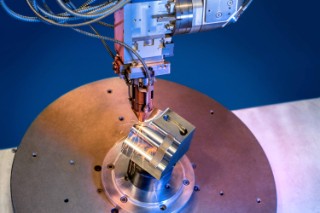
Many companies want to use metal additive manufacturing, but technical challenges are holding them back. This is exactly where Fraunhofer IPK comes in with its newly installed Wayland Calibur3.
more info
The German machine tool industry is undergoing radical changes. In his guest article for FUTUR, Dr. Jens König describes how his company, CHIRON, is responding to this change.
more info
How much autonomy can factories tolerate – and how can we ensure good working conditions in Germany?
more info
An outlook: All production facilities are digitally networked. Not only amongst each other, but across the entire company. A fast control loop between the virtual and physical worlds enables flexible adaptation of production.
more info
Machine tools are no longer sold solely based on performance. They also score points for their economical energy consumption and intelligent networking. In an interview with FUTUR, Alfred Geißler, CEO of DMG MORI AG, explains what his customers expect from modern plant technology.
more info